Pallets to Petahash: Walking a Warehouse Toward 4 PH/s
A warehouse row near 4 PH/s credits about 0.00179442 BTC a day at current difficulty, near $151.97 at $84,692 per BTC. After the listed 4% on the block-reward slice the keep is close to $145.89. The walk from boxed pallets to that figure runs through forklifts, vents, and one careful breaker survey.
Key takeaways
- 400 TH/s opens the ladder at near 0.00017944 BTC daily, about $15.20 gross at $84,692.
- Net after the listed 4% on the block-reward slice is near $14.59 a day per rig.
- 4 PH/s as a row totals $151.97 gross and $145.89 net daily.
- Phone monitoring with the ViaBTC App keeps a pallet-scale rollout observable from day one.
Morning inventory among the pallets
Sam manages weekend sports programs and inherited access to a storage warehouse with tall ceilings and cheap three-phase power. Ten boxed rigs arrived on two pallets in April, each unit rated near 400 TH/s, and the inventory morning felt closer to coaching than computing: count the boxes, check the accessories, assign rack positions like field positions. Nothing hashed that day, deliberately.
His rollout rule capped progress at two rigs per weekend. Unbox, rack, cable, ventilate, burn in for a week, then repeat. By June the row held six machines near 2.4 PH/s combined, and the dashboard showed a weekly pace the sports budget committee could actually read. Slow assembly beat fast chaos on every metric except impatience.
Racking, cable trays, and breathing room
Warehouse mining rewards boring carpentry. Sam's crew built open racks with front-to-back airflow, hung cable trays above head height, and left a full service aisle behind every row. Each 400 TH/s rig got a labeled breaker, a labeled network drop, and a laminated card showing its install date. When the seventh rig developed a hot exhaust in July, the card led the troubleshooter to a kinked duct in four minutes.
Dust control came from the building's own habits. Roller doors stay shut against the yard's afternoon grit, intake filters face the clean storage side, and a monthly blower pass keeps fins clear. A warehouse that already stores sports mats understands particulate discipline; the rigs simply joined the cleaning rota alongside the floors.
Hourly credits across a growing row
The default PPS+ mode settles the block-reward slice hourly against the 132.76 T difficulty with the pool absorbing pool luck and orphan risk, applying a listed 4% there and 2% on the fee slice. For a staged rollout this hourly feedback is gold: each newly racked rig proves itself within a day against the expected 0.00017944 BTC pace, and underperformers get flagged before the next pallet opens.
PPLNS, listed 2% across the combined reward with payment after 6 confirmations over the last 5 difficulty rounds, may suit the finished row later. During construction, though, lumpiness would have hidden exactly the faults Sam needed to see. He left the settlement default alone and spent his attention on ducts and labels instead.
From one box to a full row of numbers
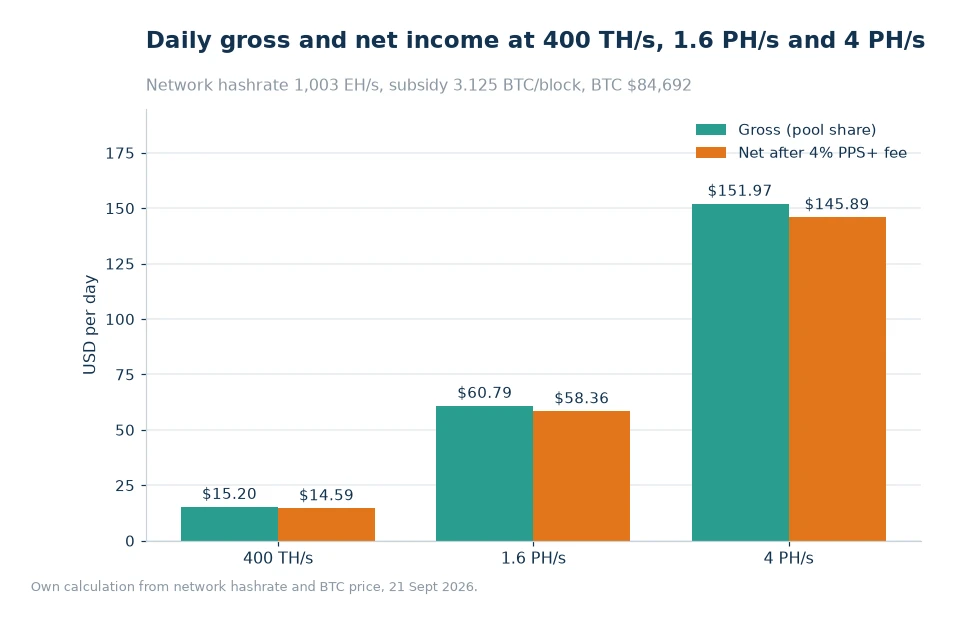
The chart compresses the rollout into three snapshots: 400 TH/s at $15.20 gross and $14.59 net, 1.6 PH/s at $60.79 gross and $58.36 net, and 4 PH/s at $151.97 gross and $145.89 net. Sam's committee tracks the middle snapshot most closely because four rigs funded the racking timber and the electrician's survey. The top snapshot sets the ceiling for the autumn debate about filling the row.
Weekly math sharpens the case. A full row at $145.89 net daily clears $1,021.23 across seven steady days before power, which dwarfs the warehouse's own rent share. Power then takes its contractual bite, metered separately per row so the sports program never subsidizes the rigs invisibly. The pool calculator page produced the gross side of that ledger in one sitting.
| Fleet on the racks | Gross a day | Net a day | Net a week |
|---|---|---|---|
| 400 TH/s, first box | $15.20 | $14.59 | $102.13 |
| 1.6 PH/s, four boxes | $60.79 | $58.36 | $408.52 |
| 4 PH/s, the full row | $151.97 | $145.89 | $1,021.23 |
The weekly column is the one Sam reads aloud at committee meetings, because volunteers think in weeks. A first box netting $102.13 a week already covers its own power and filters; a full row netting $1,021.23 funds new goalposts. Between those poles sits every sensible stopping point, each priced to the dollar.
The committee's treasurer, a retired bookkeeper, insisted on one more column that Sam had not planned: power cost per week beside the net, read from the row's own sub-meter. Her argument was short and final, that gross figures flatter while metered margins instruct. The first month with both columns showed the row keeping roughly two-thirds of its net after power at the warehouse tariff, a ratio the committee wrote into the autumn budget as its planning assumption. Sam framed the spreadsheet printout beside the rack labels, where volunteers see it while coiling cables, and nobody has proposed unmetered expansion since. The bookkeeper calls the sub-meter the only honest member of the committee, a joke told at every meeting and recorded in none of the minutes.
Pocket supervision for a forklift zone
Supervising a warehouse from a desk elsewhere demands mobile eyes. The ViaBTC App on iOS and Android carries live hashrate, worker states, and payout history with multi-account views, so Sam watches the row between training sessions. A low-hashrate alert caught a July network switch failure before the evening program started, and the fix took a spare cable from the kit bag.
He fetched the monitoring software through the ViaBTC App Download during the second install weekend and has updated it with the same discipline as the firmware. Monitoring travels in his pocket; high-voltage curiosity stays with the electrician. That division of courage has served the row well.
The autumn meeting approved two more rigs for the row, funded entirely from the summer surplus the metered columns revealed. Sam ordered the breakers first and the machines second, following the treasurer's sequence without debate. The laminated cards for slots seven and eight are already printed, waiting in the site folder beside the torque screwdriver.
Worked example
Divide 400 by 1,003,000,000 for a network fraction of 0.00000039880. Times 450 BTC of daily issuance gives 0.00017944 BTC a day. Times $84,692 gives $15.20 gross. Times 0.96 under the listed 4% on the block-reward component gives $14.59 net, the chart's opening rung.
Four boxes at 1.6 PH/s are 1,600 TH/s: 0.00071777 BTC daily, $60.79 gross, $58.36 net. Ten boxes at 4 PH/s are 4,000 TH/s: 0.00179442 BTC daily, $151.97 gross, $145.89 net. So 400 TH/s = 0.00017944 BTC/day = $15.2 gross, $14.59 net and 4 PH/s = 0.00179442 BTC/day = $151.97 gross, $145.89 net, exactly the chart note's ladder.
Frequently asked questions
How fast should a warehouse row grow?
Two rigs per weekend at most. Each 400 TH/s box needs a burn-in week against its $15.20 gross expectation before the next pallet opens, so faults stay traceable to one install.
What does the row earn weekly before power?
About $1,021.23 at full strength. Seven steady days at $145.89 net each total $1,021.23, metered separately from the building so the sports budget sees the true margin.
Does phone monitoring replace site rounds?
No, it schedules them. Alerts flag the fault within minutes while monthly blower passes and filter checks prevent most faults, and the app's payout history confirms the $14.59-per-rig pace.
Fill the row only as fast as the labels allow
Sam's rule for autumn fits the laminated cards: rack it, label it, burn it in, then count it on the network statistics view before unboxing the next. A warehouse that grows at the speed of its own paperwork reaches 4 PH/s with every breaker named and every duct straight. Pallets become petahash one careful weekend at a time.
Sources: ViaBTC calculator, app download and statistics pages for estimation, monitoring and difficulty context[1]. Chain inputs read 21 Sept 2026: network hashrate about 1,003 EH/s, difficulty 132.76 T, subsidy 3.125 BTC per block, 144 blocks a day, BTC $84,692. Published 24 Oct 2026; figures are arithmetic on those inputs.