Ordering RTA Cabinets: A Step-by-Step Checklist
An order goes wrong in the first hour, long before the cart is submitted: a wall measured from the old cabinet instead of the studs, a style chosen from a screen, a total that lands just under the $2,500 free-shipping line. CasaBuilt publishes flat-packed dispatch at 3-10 business days, which gives the buyer very little room to correct a mistake after checkout. The checklist below works through the sequence in the order the decisions actually arrive.
Key takeaways
- Base cabinets are 34-1/2 inches high and 24 inches deep; wall cabinets are 12 inches deep in 30, 36 and 42 inch heights.
- Samples cost $9.99 and are refundable with a cabinet purchase.
- Free shipping starts at $2,500, and a starter kitchen usually falls short of it.
- There is no long correction window: flat-packed dispatch is 3-10 business days, so the list has to be right before checkout.
Step one: measure the room, not the old doors
Start with the wall, not with the cabinet that is already hanging on it. Measure the clear length at three heights, because a plastered wall is rarely straight, and note the shortest of the three as the usable run. Then measure the ceiling height at both ends of the run and the depth available for the base cabinets from the wall to the first obstruction.
Write down every fixed item and its width: range, refrigerator, sink, dishwasher, radiator, door swing. CasaBuilt publishes a measurement guide for the parts that matter, and the reason is simple. The base cabinet is 34-1/2 inches high and 24 inches deep, and the wall cabinet is 12 inches deep in a 30, 36 or 42 inch height. Those are fixed values, so the room has to be fitted around them rather than the other way round.
Finish the step with a single sheet of paper showing wall lengths, appliance widths, ceiling height and the location of every outlet and water connection. Every later decision is checked against that sheet.
Step two: choose a style, then spend $9.99 on the doubt
Styles that look similar on a screen differ in ways that only show at arm's length: panel depth, edge shadow, how the paint catches a window. CasaBuilt keeps 16 door samples in stock at $9.99 each, refundable with a cabinet purchase, and the mix is weighted toward the Shaker family at 8 Shaker, 3 Double Shaker, 3 Slim Shaker and 2 Frameless samples. White accounts for five of the range, gray for three and brown for two, with black, beige, green and navy completing the set.
Two samples are priced separately on the Slim White Oak page: Black Quarterline at $19.50 and Beach Impression at $22.00. Order those if the plan leans toward a wood-look door rather than a painted one, because color on a screen is the least reliable part of an online cabinet order.
Hold each sample against the counter, the floor and the light from the window, and keep the one that survives daylight rather than the one that looks best under a kitchen spotlight. The sample range is small enough to order the whole shortlist at once.
Step three: turn the list into a cabinet schedule
A schedule is a table with one row per cabinet: width, type, door or drawer configuration, and the wall it belongs to. Build it from the published width ladder, which runs 9, 12, 15, 18, 21, 24, 27, 30, 33, 36, 39 and 42 inches for base cabinets, with wall cabinets from 9 to 39 inches. CasaBuilt sells the whole line as rta cabinets in those fixed widths, so every row on the schedule maps to a listed product and the cart can be built from the sheet. If a row needs a width that is not on the ladder, the layout needs changing, not the cabinet.
Then check the schedule against the fixed items from step one. The refrigerator opening, the range gap and the sink center are the three places where a list that reads perfectly on paper fails on site. CasaBuilt's free 3D design is delivered in 24-48 hours and is a useful second pair of eyes on exactly this check, but the design is only as accurate as the measurements it starts from.
Add the finish hardware, the toe kick and any filler to the schedule before pricing it. Small parts are easy to forget and awkward to add to a flat-packed order that ships in 3-10 business days.
Step four: price it against the freight line
Freight is the last line of the order and the one most often ignored. CasaBuilt charges no freight once the cart passes $2,500, and orders bound for Alaska or Hawaii stay outside the standard flat-packed window. A starter kitchen in the cheaper painted lines lands below that threshold, so the freight question is live for most first orders.
That changes how the cart is built. A buyer who is $200 short of free shipping can add a wall cabinet, a set of shelves or a spare door and cross the line, provided the addition is something the kitchen will use. A buyer who is $1,300 short is looking at a different decision: pay the freight, or buy the second phase of the kitchen now and store it.
| Style | Basic kitchen price | Gap to free shipping | Practical move |
|---|---|---|---|
| Hudson Grey Shaker | $1,184.93 | $1,315.07 | Plan a second phase or accept freight |
| White Shaker | $1,199.50 | $1,300.50 | Same decision, marginally different numbers |
| Navy Blue Shaker | $1,230.69 | $1,269.31 | Add pantry storage to close the gap |
| Smokey Ash Shaker | $1,932.42 | $567.58 | One tall cabinet or two wall units |
| Slim Aston Green Shaker | $2,148.28 | $351.72 | One double wall cabinet crosses it |
| Slim White Oak | $2,295.64 | $204.36 | Add a bridge cabinet or samples and shelves |
None of this argues for buying cabinets you do not need. It argues for pricing the whole order before checkout rather than discovering the freight charge at the last screen, when changing the list means starting the schedule again.
Worked example: closing a $1,500 order to the threshold
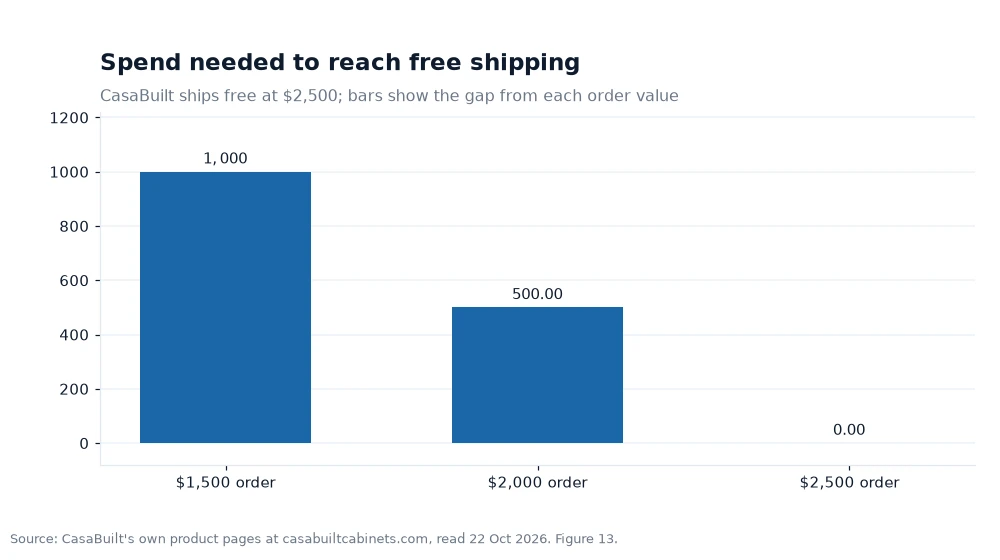
The chart shows what each order value still needs before shipping is free. At $1,500 the gap is $1,000, because $2,500 minus $1,500 is $1,000. At $2,000 the gap is $500, and at $2,500 the gap is $0. The chart is arithmetic on the published threshold, not a discount schedule.
Take an order of $1,500 that already includes the sink base and the range run. A 30-inch double-door wall cabinet is $347.76, which brings the order to $1,847.76 and leaves $652.24 to find. A 30-36 inch sink base at $429.84 would take it to $2,277.60, still $222.40 short. Adding one more 30-inch double-door wall cabinet at $347.76 takes the total to $2,625.36, which crosses the line by $125.36.
Read the result honestly. Crossing the threshold cost $1,125.36 in extra cabinets, and those cabinets have to be wanted. If the second wall cabinet was already on the schedule, the order was simply sequenced badly. If it was not, paying freight on $1,500 is the cheaper decision, because buying a cabinet to save a freight charge is not a saving.
Frequently asked questions
How much does it cost to see a door before ordering?
Samples are $9.99 each against a list price of $19.99, and the fee is refundable with a cabinet purchase. Two premium finishes are priced separately: Black Quarterline at $19.50 and Beach Impression at $22.00. With 16 samples in stock, ordering the full shortlist costs less than a single filler panel.
Do I need the design service to place an order?
No. The free 3D kitchen design is optional and delivered in 24-48 hours, and the trade version quotes room designs in less than 72 hours. It is most useful as a check on a layout that is already measured, not as a substitute for standing in the room with a tape measure.
What happens if the order comes in under $2,500?
Standard freight applies, and Alaska and Hawaii are excluded from the flat-packed shipping window regardless of order value. The useful move is to price the full schedule first and decide whether a wanted addition closes the gap. Buying an unneeded cabinet to reach the threshold usually costs more than the freight it avoids.
Place the order once, with the sheet in front of you
Check the schedule against the measurements one final time, confirm the style name and width on every row, and read the shipping window as a business-day range rather than a delivery date. Then submit the order and keep the confirmation with the measurement sheet.
Flat-packed cabinets arrive as boxes, so the last checklist item is storage: a dry, flat space where the cartons can wait until installation day without being stacked on their faces.
Figures quoted here come from the manufacturer's own website, read 22 Oct 2026[1.