How Capacity Classes Decide Your Equipment List
The capacity class you buy in decides almost everything that follows: how many vessels the brewhouse has, how many fermentation tanks sit behind it, how much chilling you need and whether packaging is a filler or a hand-capper. HGMC publishes classes from a nano set of five barrels or less up to large commercial plants, within an overall span of 100 L to 200 T, so the honest first step is to find your class rather than to choose vessels one at a time.
Here is how the published classes differ, and how to turn an annual volume target into a list you can actually order.
Key takeaways
- Published classes: a nano set of 5 BBL or less, microbrewery equipment from 1,000 L making 18,000 barrels or less a year, micro craft systems of 1,000 to 3,000 L, and large commercial plant up to 100 HL.
- The published span runs from 100 L to 200 T overall, with single machines from 1 BBL to 100 BBL, so the class names overlap the machine sizes on purpose.
- Chilling scales with batch volume and crash time, not with the number of tanks: crashing 3,000 L from 95 to 12 degrees Celsius is about 289 kilowatt hours of cooling.
- Published applications show the range in practice, from 200 L and 500 L installations to 3,500 L systems and 20 T plants.
The published classes, one line each
A nano brewery is published as a system of 5 BBL or less that takes little space, which is the class that fits a restaurant, a taproom corner or a test kitchen. Microbrewery equipment is published as producing 18,000 barrels or less a year and can be installed in restaurants, commercial and industrial buildings. The micro craft class is published as 1,000 L to 3,000 L. Large commercial systems reach equipment sizes up to 100 HL, and the same pages state that whether a buyer starts at half a barrel or goes beyond 100 BBL, the components are specified and integrated as one package.
Reading those four lines together explains why the class, not the machine, is the useful unit of planning. A 1,000 L brewhouse sold as microbrewery equipment and a 1,000 L brewhouse sold as a micro craft system differ mainly in the tank farm, the cooling and the packaging behind them.
The published application cases show how wide that spread is in practice. They include a 200 L installation in Australia, 500 L systems in Hungary, Denmark, the Netherlands and Germany, 1,000 L plants in Korea, Canada, Spain, Costa Rica and the United States, 2,000 L systems in England, Italy, Estonia and Korea, a 3,500 L brewery in France and a 20 T plant in Poland. Two facts follow from that list. Volume targets of the same apparent size are bought in different classes depending on how the beer is sold, and the difference between a 500 L and a 2,000 L project is mostly a difference in the tank farm, the chiller and the packaging line rather than in the brewhouse shell.
What each class changes in the equipment list
Move up one class and the brewhouse changes least. Vessel count goes from two to three, four or five as brew frequency rises, and heating moves between electric, steam and gas according to the building. What changes most is everything downstream: fermentation and bright tanks in proportion to batch volume, a glycol system sized for the total tank volume, and a packaging decision that stops being manual somewhere in the middle of the range.
Cooling deserves its own line in the budget. Every class from nano upward needs a chiller, a glycol tank, cooling pipes and valves, but the load is driven by how fast you want to crash a batch rather than by how many tanks you own. Double the batch and, at the same crash time, you nearly double the chiller.
| Class | Brewhouse | Tanks and cooling | Packaging | Published span |
|---|---|---|---|---|
| Nano | Compact set, two vessels in most builds | One or two small tanks, small chiller | Kegs and hand-filled containers | 5 BBL or less |
| Micro craft | Two or three vessels, 1,000 to 3,000 L | Three to four tanks, glycol tank and chiller | Kegs, with a small filler optional | 1,000 L to 3,000 L |
| Microbrewery | Three or four vessels as brew frequency rises | Tank farm sized for weekly output | Keg line plus can or bottle filler | Up to 18,000 barrels a year |
| Large commercial | Four or five vessels, scheduled across shifts | Multiple tanks, larger chillers, CO2 recovery as an option | Full canning or bottling line | Equipment to 100 HL, packages to 200 T |
Worked example: from an annual target to a tank list
My assumptions, stated so you can swap in your own: a target of 1,500 hectolitres of saleable beer a year, a 3,000 L brewhouse in the micro craft class, 1 hectolitre taken as 100 L, a 21-day tank cycle, and 20 per cent headroom over the minimum batch count.
Step one, litres per year: 1,500 HL multiplied by 100 is 150,000 L. Step two, batches a year: 150,000 L divided by 3,000 L is 50 brews, or about one brew a week. Step three, add headroom: 50 batches multiplied by 1.2 is 60 batches a year. Step four, tank turns: 365 divided by a 21-day cycle is about 17.4 turns per tank each year.
Step five, fermentation tanks: 60 divided by 17.4 is about 3.4, so four vessels of 3,000 L cover the plan with a spare tank free for a seasonal beer. Step six, the cooling load for one of those batches: 3,000 kg of wort cooled by 83 kelvin, from about 95 down to 12 degrees Celsius, is 3,000 multiplied by 4.18 multiplied by 83, or 1,040,820 kilojoules, roughly 289 kilowatt hours. Crash a batch in six hours and the chiller has to be able to move about 48 kilowatts; stretch the crash over twelve hours and the same 289 kilowatt hours need only around 24 kilowatts, which is a smaller and cheaper chiller for the same beer.
Frequently asked questions
What size counts as a microbrewery?
Published microbrewery equipment produces 18,000 barrels or less a year and can be installed in restaurants and commercial or industrial buildings, while the micro craft class is defined as 1,000 L to 3,000 L. A nano set is 5 BBL or less, and large commercial systems run to equipment sizes of 100 HL.
How many fermentation tanks does one capacity class need?
Divide the batches you need each year by the turns one tank completes, which follows your cycle length. On a 21-day cycle a tank turns about 17 times a year, so a 60 batch plan needs roughly four 3,000 L vessels once you allow headroom for a seasonal beer.
Fix the class before you fix the price
Write your annual litre target, your batch size and your acceptable crash time on one page, then let the class do the work of choosing the list. The published hgmc brew system families are grouped by capacity class, so you can see immediately which tank farm and cooling package belongs with the brewhouse you are considering.
For the two classes most small breweries land in, the micro craft brewing kit pages and the large commercial plant pages set out how the components are specified together rather than as separate machines. Read both before you commit to a vessel count, because moving up a class later costs far more than specifying it at the start.
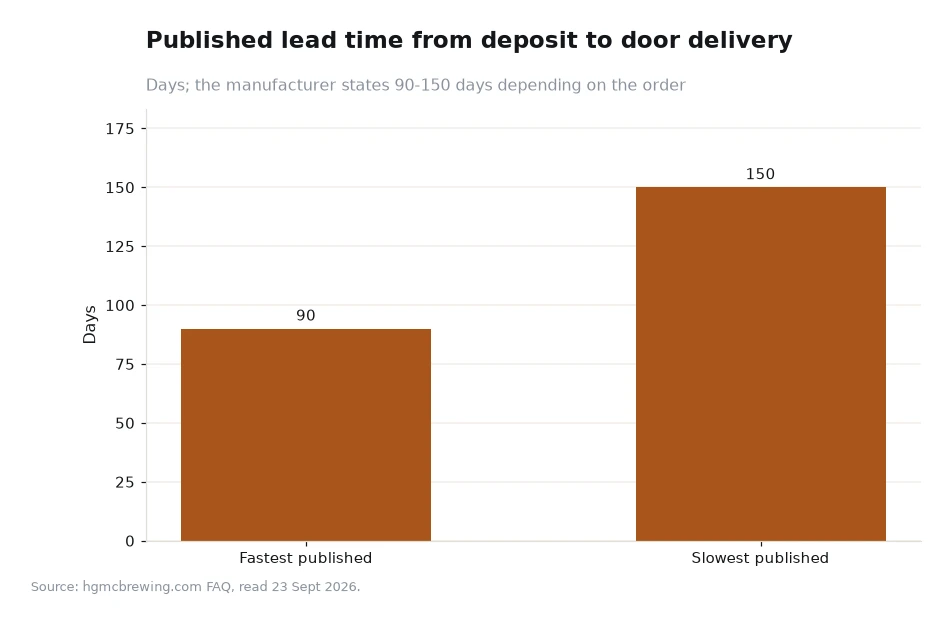
Published capacity classes, machine sizes, application cases and the 6-year warranty on tank accessories and electronic components against manufacturing defects come from the manufacturer's own website, read 23 Sept 2026; the batch counts, tank calculations and cooling figures above are my own arithmetic from the stated assumptions.[1] Delivery runs from deposit to door delivery in 90 to 150 days depending on the order.