How to Evaluate a Fragrance OEM/ODM Supplier: The Signals That Matter
Evaluating a fragrance OEM/ODM supplier is mostly an exercise in reading behaviour rather than credentials. Certificates tell you which management systems exist; the way a supplier answers a technical question, scopes its own work and handles a correction tells you whether those systems are doing anything. Use the credentials as a filter, then score the behaviour.
Key takeaways
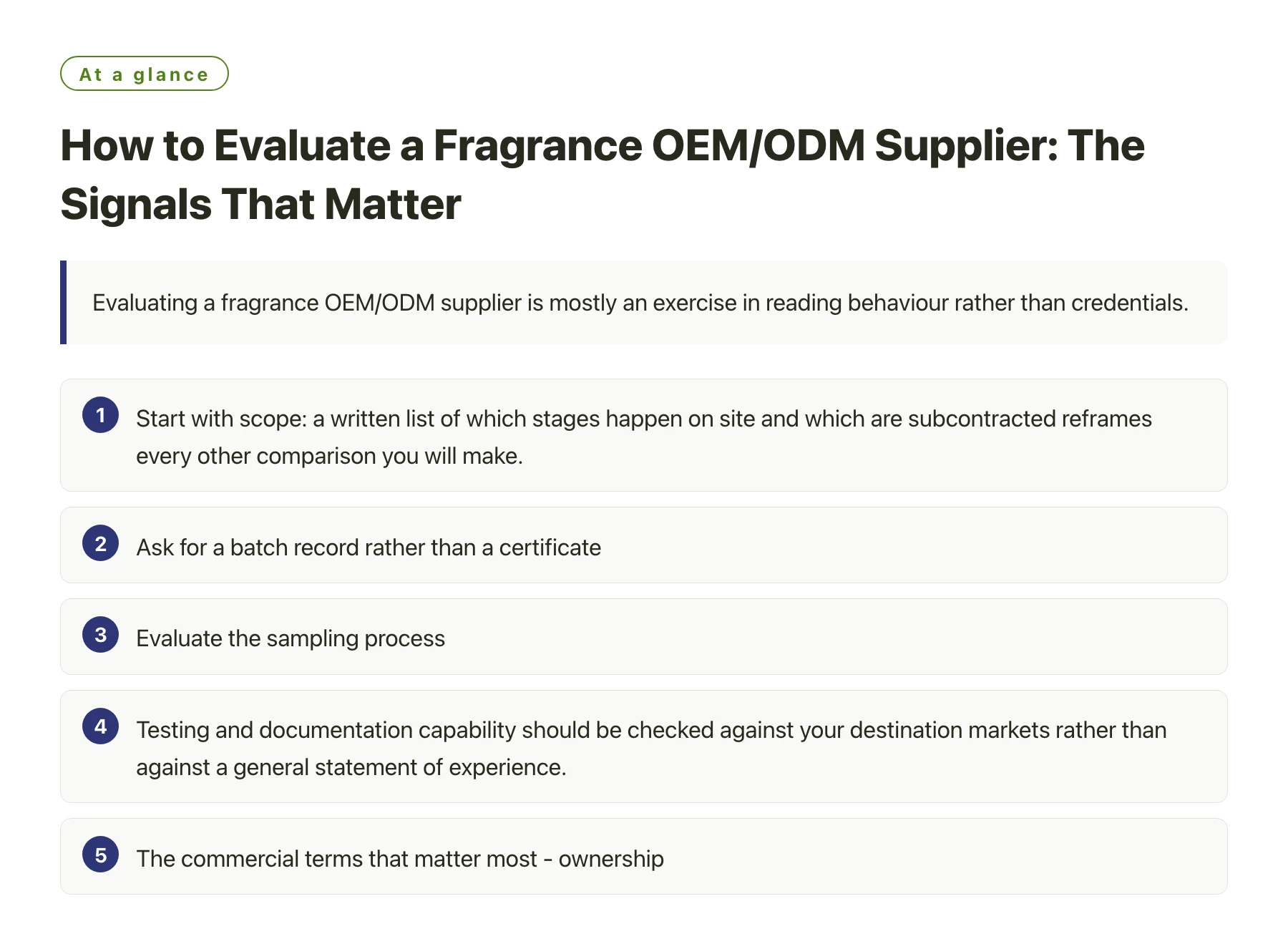
- Start with scope: a written list of which stages happen on site and which are subcontracted reframes every other comparison you will make.
- Ask for a batch record rather than a certificate, because a record shows what happened on a specific run instead of what a system claims to do.
- Evaluate the sampling process, not just the samples; the correction cycle predicts the bulk run more accurately than the first sample does.
- Testing and documentation capability should be checked against your destination markets rather than against a general statement of experience.
- The commercial terms that matter most - ownership, exclusivity, MOQ logic and change control - are the ones suppliers mention last.
This framework is written for a brand that has already decided between OEM and ODM and now needs to choose between two or three suppliers that all look credible on paper. At that stage the goal is not to find the perfect factory but to find the one whose process you can observe and rely on.
The sequence below is deliberately ordered. Each step tells you whether the next one is worth doing.
A five-step evaluation sequence
- 1. Ask for the scope in writingRequest a list of every stage from compounding to packing, marked as performed on site or bought in. This is the single most useful document in the whole evaluation, because it tells you where lead time and quality risk actually sit.
- 2. Walk one batch record end to endPick a recent production run and ask to follow it from raw material intake to release. A supplier working to a cosmetics GMP framework will have the record structured and available, because traceability is the point of the system [1].
- 3. Run a test briefSend a short, realistic brief and watch the response. What they ask, how fast they answer, and whether the first sample arrives with a technical sheet tell you more than a plant tour.
- 4. Send one deliberate correctionAfter the first sample, request a specific adjustment in the language of the material - more brightness at the top, less sweetness in the base. How the second sample moves shows you whether feedback is reaching the perfumer or a salesperson.
- 5. Test the commercial termsAsk about formula ownership, exclusivity, MOQ reasoning, tooling, change control and what happens if a component is discontinued. Suppliers who answer these precisely are used to being asked.
Signal, good answer, warning sign
| Signal | What a strong supplier does | What a weak one does |
|---|---|---|
| Scope question | Sends a written stage list with the subcontracted steps marked | Says everything is done in house without documentation |
| Batch record request | Offers a walkthrough of a real record, redacted where needed | Sends a certificate and changes the subject |
| Technical questions | Answers in material terms, and says when the answer is unknown | Answers every question confidently and vaguely |
| Correction round | Explains what changed in the formula and why | Returns a sample with no explanation of the change |
| MOQ discussion | Explains which of compounding, filling or decoration sets the minimum | Quotes a single minimum with no breakdown |
| Change control | Describes what happens when artwork or a component changes mid-project | Treats changes as a commercial conversation rather than a process one |
| References | Offers a technical contact, not only a sales one | Offers only the salesperson who is already talking to you |
Score the rows rather than the impression. Two or three warning signs in the technical rows are more significant than any number of certificates in a brochure.
What to verify in writing before you sign
Verbal assurances about process are worth having, but they do not survive a change of account manager. Four points belong in the contract, and they should be written as though a fragrance OEM/ODM production partner will read them without the person who negotiated them.
Ownership of formula, mould and artwork
Say who owns the formula under your chosen model, who owns a mould the brand pays for, and who holds the artwork files. If the answer is the supplier in each case, that is a legitimate commercial position - but it needs to be a decision rather than a default discovered later.
The approval reference
Name the retained sample, who holds it, and how bulk release is judged against it. Approval by photograph or by description creates disputes that no amount of goodwill resolves, because neither party has an object to compare.
Documentation for the destination markets
State which markets you are shipping to and what the supplier will provide for each. Then verify independently; a certification list describes a management system, not the compliance of your specific product in your specific market.
Change control and lead time
Define what a change to artwork, dosage or pack means for cost and schedule. This clause is rarely examined at signature and constantly referenced afterwards.
One practical shortcut: ask each supplier what they would want to know about your project if they were the brand. The answers reveal whether they think in terms of risk and process or in terms of what they can sell you. A factory that describes itself as fragrance manufacturing under one roof usually has a more useful answer, because the choice between developing a concept and building to your formula is one it makes every week.
The evaluation question most brands skip
Almost nobody asks what the supplier will refuse to do. A factory that will decline a project is one that has a view about what it can execute well, and that view is exactly what you are trying to buy. A supplier that never says no is telling you that it has not thought about fit, or that it will say anything to win the order.
The second skipped question is about the second order. First orders get attention; repeat orders get scheduled. Ask how repeat runs are handled, whether a formula is held in stock, and how long a reorder takes. That answer describes the relationship you will actually have.
If you want a structured way to run the whole exercise, start from a checklist written by a manufacturer and test it against your own. Comparing it with a formal due-diligence sequence such as Xuelei, carried out by someone with no commercial interest in the outcome, is the other half of the exercise. Where two independent frameworks raise the same question, that question is usually the one that matters in your category.
Sources
- SGS: Cosmetics, Personal Care & Household Testing —— Testing, inspection and certification services for cosmetics and personal care, including microbiological, stability and safety testing aligned with cosmetics GMP.
Frequently asked questions
What is the first thing to check on a fragrance supplier?
The written scope: which stages they perform themselves and which they subcontract. Every later comparison, from cost to lead time, depends on that answer.
Are certifications enough to qualify a supplier?
No. They confirm that a management system has been audited, which is a useful filter. The batch record is what shows whether the system is being used on the line.
How many samples should a test brief involve?
One brief and one correction round is usually enough to see how information flows between the sales contact and the technical team. Two suppliers tested this way will differentiate themselves quickly.
What should happen if a supplier cannot answer a technical question?
That is not automatically a problem - saying you do not know is a good sign. The problem is the follow-up: whether the answer arrives later, in writing, with a named source.
When should commercial terms be discussed?
Alongside the technical evaluation rather than after it. Ownership, exclusivity and change control affect what the supplier is willing to develop, so they shape the technical proposal.