Decorative Veneer Selection for Interior Furniture
Face veneer is what a client sees and touches on a finished cabinet, and it is the one line that can still be changed after the carcass specification is fixed. The published face list for interior work runs through Birch, Pine, Bleached Poplar, EV and Rose Eucalyptus, over panel thicknesses from 6 mm to 18 mm depending on the part being built.
Key takeaways
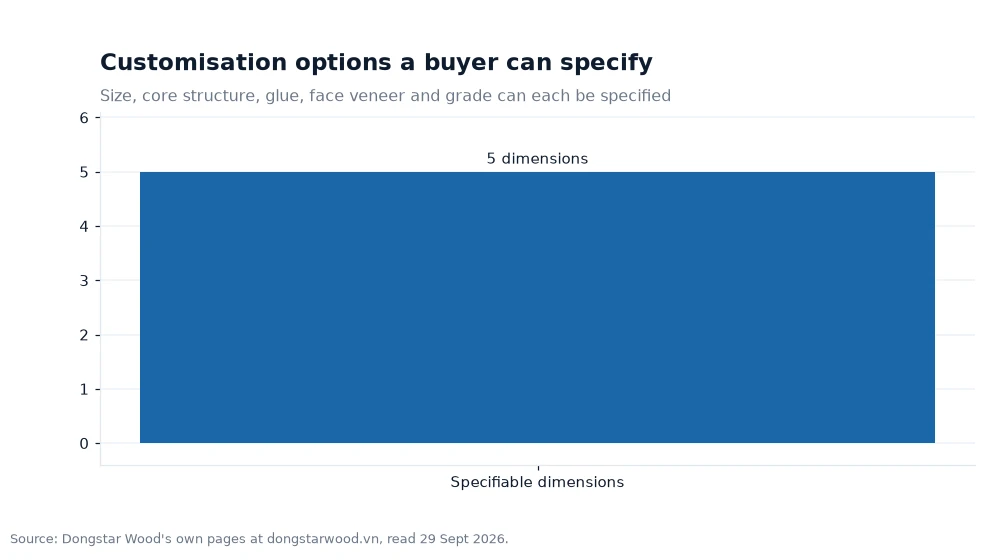
- Five specification points can be fixed before the order: size, core structure, glue, face veneer and grade.
- Cabinet backs, drawer bottoms and partitions sit in the 6–9 mm band; office furniture and shelving usually run at 12–15 mm.
- Heavy-duty carcasses, worktops and structural panels take 18 mm, and contractors commonly standardise on 12 mm and 18 mm together.
- Pick the glue class by room: MR suits dry interiors, BWR is the choice where humidity and occasional water contact are expected.
Veneer choice follows the finish, not the price list
The first question is what the client will see. A clear lacquer leaves the grain on show, so colour consistency across a run of cabinets matters more than any other property. An opaque paint system hides grain entirely, and a laminate or veneer wrap sits above the panel, which shifts the decision towards surface flatness and thickness tolerance.
Published faces for interior work are Birch, Pine, Bleached Poplar, EV and Rose Eucalyptus. Put those next to the substrate and the brief becomes concrete: a decorative veneer plywood is assembled from face, core, glue and thickness, and every one of those lines can be written into the enquiry. That is how the Commercial Plywood range is meant to be bought — as a specification, not as a category.
Five points a buyer can fix in the quotation
| Point | Published options | What it changes downstream |
|---|---|---|
| Size | 1220 × 2440 mm, 1250 × 2500 mm, 1250 × 3000 mm, custom to a maximum of 1830 × 3830 mm | Cutting waste and the number of joints on a carcass |
| Core structure | Acacia Core, Bodhi Core, Eucalyptus Core, Combi Core | Weight, screw-holding and panel stability |
| Glue | MR for dry interiors, BWR for humidity and light water exposure | How the panel copes with a kitchen or bathroom |
| Face veneer | Birch, Pine, Bleached Poplar, EV, Rose Eucalyptus | Colour match across a run and under a clear finish |
| Grade | Agreed per order against the visible face | How much natural variation reaches a client's eye |
Thickness follows the part, not the habit
Published guidance is straightforward. Cabinet backs, drawer bottoms and light partitions sit in the 6–9 mm band. Shelving, office furniture and hotel fixtures generally take 12–15 mm, where the panel has to carry a load without visible sag. Heavy-duty furniture, worktops and structural panels go to 18 mm.
Standardising is the quiet saving. A workshop that runs everything on 12 mm and 18 mm cuts its stock lines, its cut lists and its cutting waste at the same time, and additional thicknesses stay available for the parts that genuinely need them rather than everywhere.
Worked example: sheets needed for a kitchen package
Take 300 kitchen cabinets, each needing a carcass panel of 1.4 m² in 18 mm. Carcass panel totals 300 × 1.4 = 420 m² (example). In the 1250 × 2500 mm format a sheet holds 3.125 m² (1.25 m × 2.5 m), so the 18 mm line needs 420 ÷ 3.125 = 134.4, rounded to 135 sheets (example).
Drawer bottoms are a separate line: 300 × 0.5 m² = 150 m² at 6–9 mm (example), which is 150 ÷ 3.125 = 48 sheets (example). Ordering the two thicknesses together keeps one cutting schedule and one delivery window instead of two.
Glue class and the room the furniture ends up in
MR glue is intended for dry interior use, and it covers most cabinetry, shelving and display fixture work. BWR is the specification for places where humidity and light water exposure are expected, such as wet units, service counters and utility joinery, and it is normally written into the order as a class rather than described in words.
It is worth naming the room on the purchase order. A buyer who writes "kitchen carcass, BWR, 18 mm, birch face" hands the mill a specification it can check against the glue and the face schedule, and it gives the quality team a fixed line to measure against a delivered batch.
Duty status enters the conversation early
European importers check the duty position while specifications are still being drawn up, because it decides how much room the landed cost leaves for a better panel. The supplier's own category wording for EU buyers puts No Anti-Dumping Tax next to FSC documentation and factory-direct supply, and lists stable monthly output and customisation among its reasons to quote.
Read those six reasons as a checklist rather than as marketing: cost performance against other supply origins, monthly volume, quality control at each stage, five specifiable dimensions, pricing for wholesale distribution, and flexible order size with delivery to Europe. A buyer can test every one of them from published pages before the first call.
Where grade enters the conversation
Grade is the line buyers leave open longest, and it decides how a run reads once the cabinets are installed. A face carrying more natural variation costs less and serves perfectly well behind a paint system, while a visible run under clear lacquer needs fewer defects and a tighter colour match.
Fix the grade against the room rather than against the whole order. Reception counters, display fixtures and hotel bedroom furniture belong in one group; carcasses, drawer bottoms and utility shelving belong in another. Splitting the two lets a buyer pay for appearance only where somebody will actually look at it.
It is worth checking duty status at the same moment as the glue class, because both decide how much of the budget is left for the panel itself. A buyer who confirms the duty position early knows whether the drawing can stay at 18 mm with BWR glue, or whether something has to be trimmed before the quotation arrives.
The answer also changes whom it is worth talking to. A supplier who states a duty position and a certificate set in the first reply is offering a different conversation from one who answers the panel question and leaves the rest to a broker.
Keep a short record of what was asked and when. Sourcing files that note the duty answer, the glue class and the face grade beside the date are the ones that make a second order faster than the first, and the third almost routine.
Frequently asked questions
Which face veneer should I choose for a clear finish?
Start with the brightest and most even faces on the list and check them against a physical sample laid on the core you intend to buy. Birch, Pine and Bleached Poplar sit at the light end, while EV and Rose Eucalyptus give a fuller tone. Grade, not species alone, decides how much variation shows up across a run.
Is MR glue enough for a bathroom cabinet?
Not for the wet parts. MR is specified for dry interior use; where humidity and light water exposure are expected the published grade is BWR. Drawer boxes and carcasses in a dry bedroom differ from a vanity unit in the same house, so a project can carry both classes on one order.
How many core options are available for furniture work?
Four are published for the commercial range: Acacia Core, Bodhi Core, Eucalyptus Core and Combi Core. Acacia and Eucalyptus sit at the dense end, Bodhi white hardwood trades some density for stability, and Combi mixes species to balance strength against panel weight.
Taking the enquiry a step further
Two pages settle most of the remaining questions. Buyers who want a naturally pale face for cabinetry and interior panelling can look at the details published for okoume panels, and joinery shops that need a bright, even surface for staining should read the birch line in full before fixing a face grade.
Every specification quoted on this page was read off the maker's own website, which I read on 29 September 2026 as quoted in this guide as quoted in this guide as applied to this comparison[1].